
Speed
Lightning-fast access to your menu bar items is now even better. Get instant access to your hidden menu bar items simply by swiping or scrolling in the menu bar, clicking on the menu bar, or if you prefer, simply hovering.
Bartender is an award-winning app for macOS that for more than 10 years has superpowered your menu bar, giving you total control over your menu bar items, what's displayed, and when, with menu bar items only showing when you need them.
Bartender improves your workflow with quick reveal, search, custom hotkeys and triggers, and lots more.
Lightning-fast access to your menu bar items is now even better. Get instant access to your hidden menu bar items simply by swiping or scrolling in the menu bar, clicking on the menu bar, or if you prefer, simply hovering.
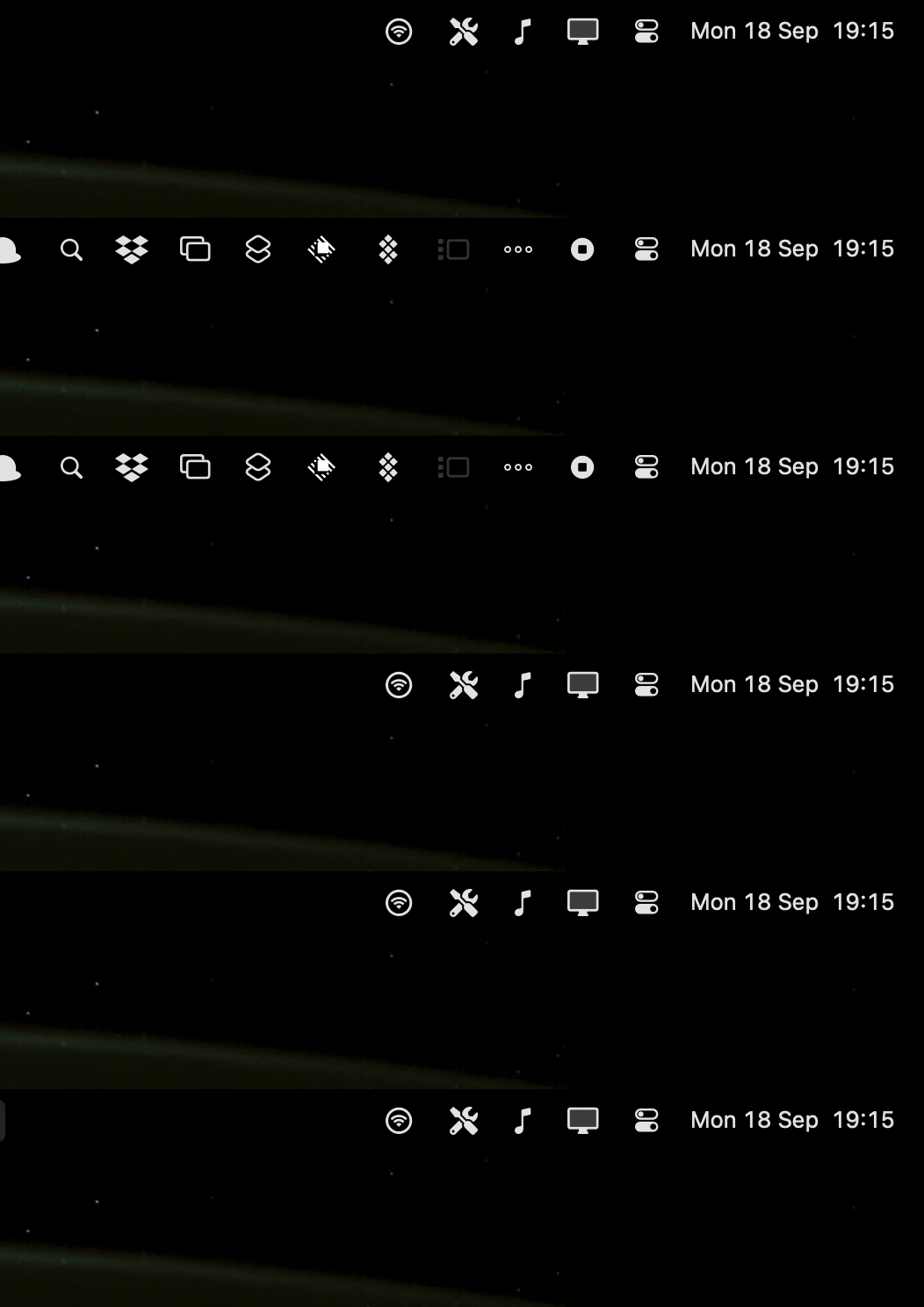
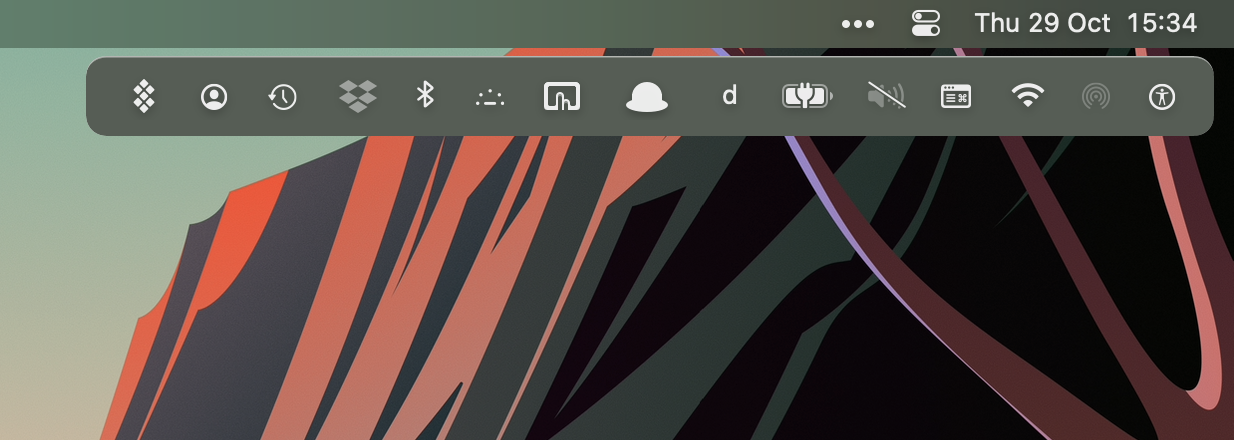
Access the menu bar items otherwise hidden by the notch on MacBook Air and Pro screens. Bartender will automatically hide your currently shown menu bar items when needed to create room to show the items hidden by the MacBook Air and Pro screens notch, giving you access to all your menu bar items.
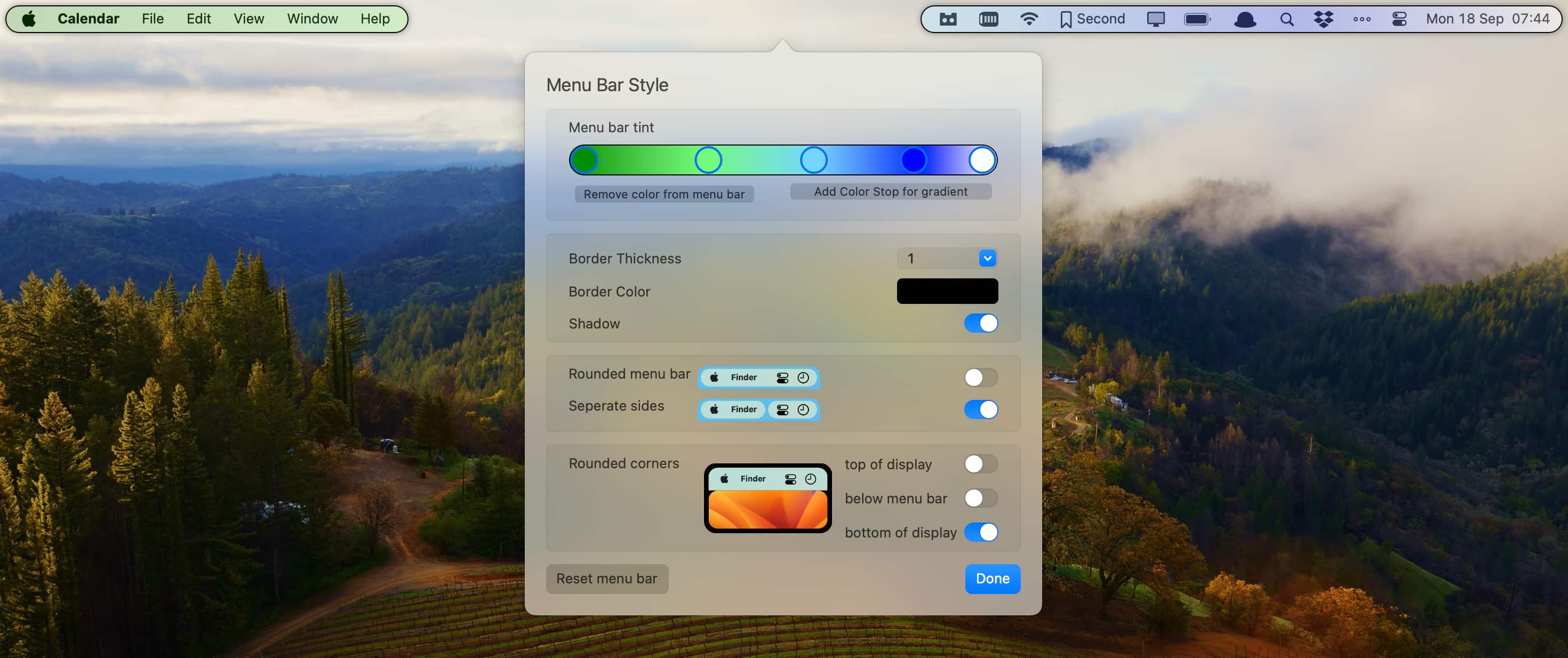
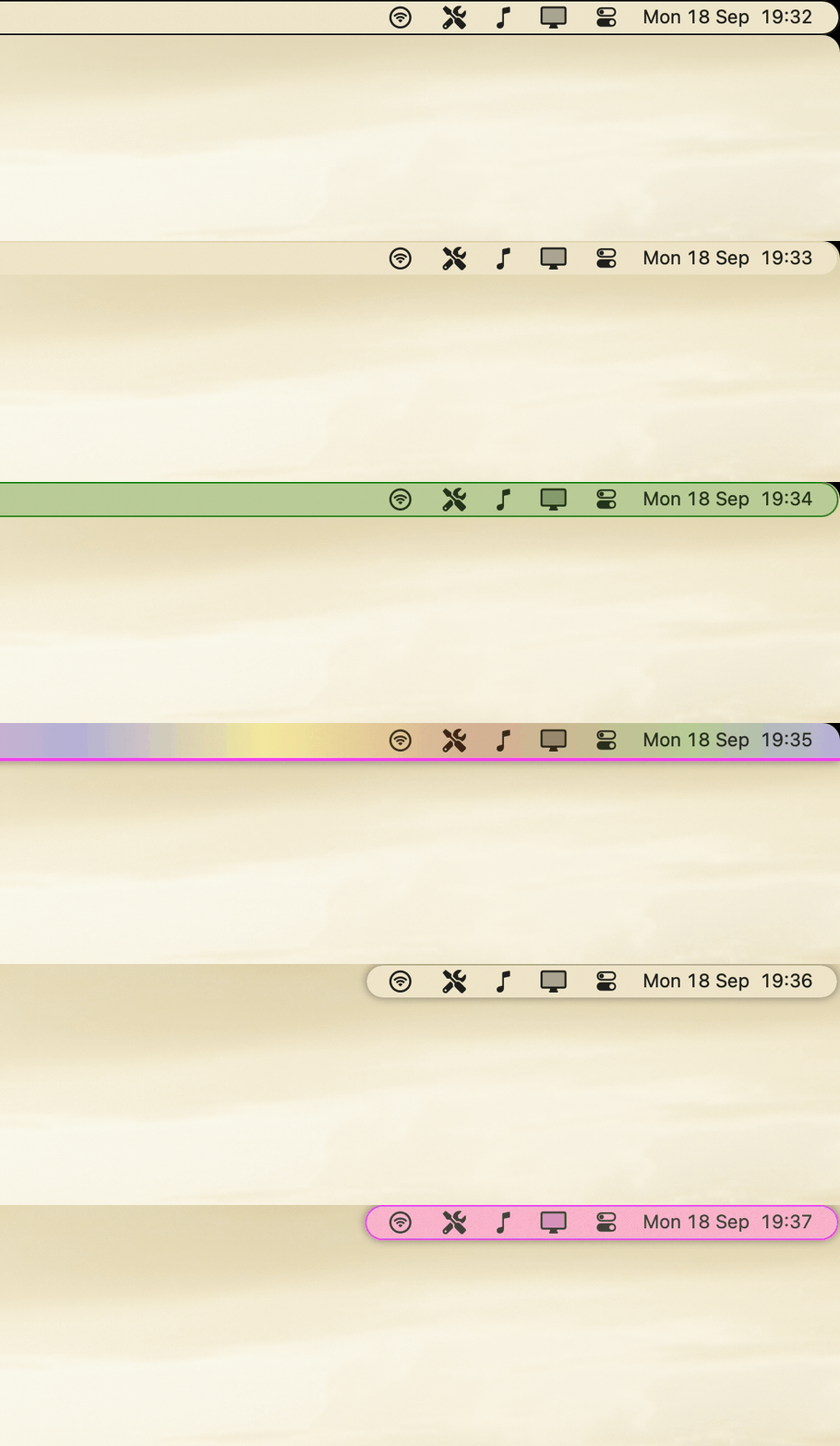
Make your menu bar your own, with menu bar styling you can:
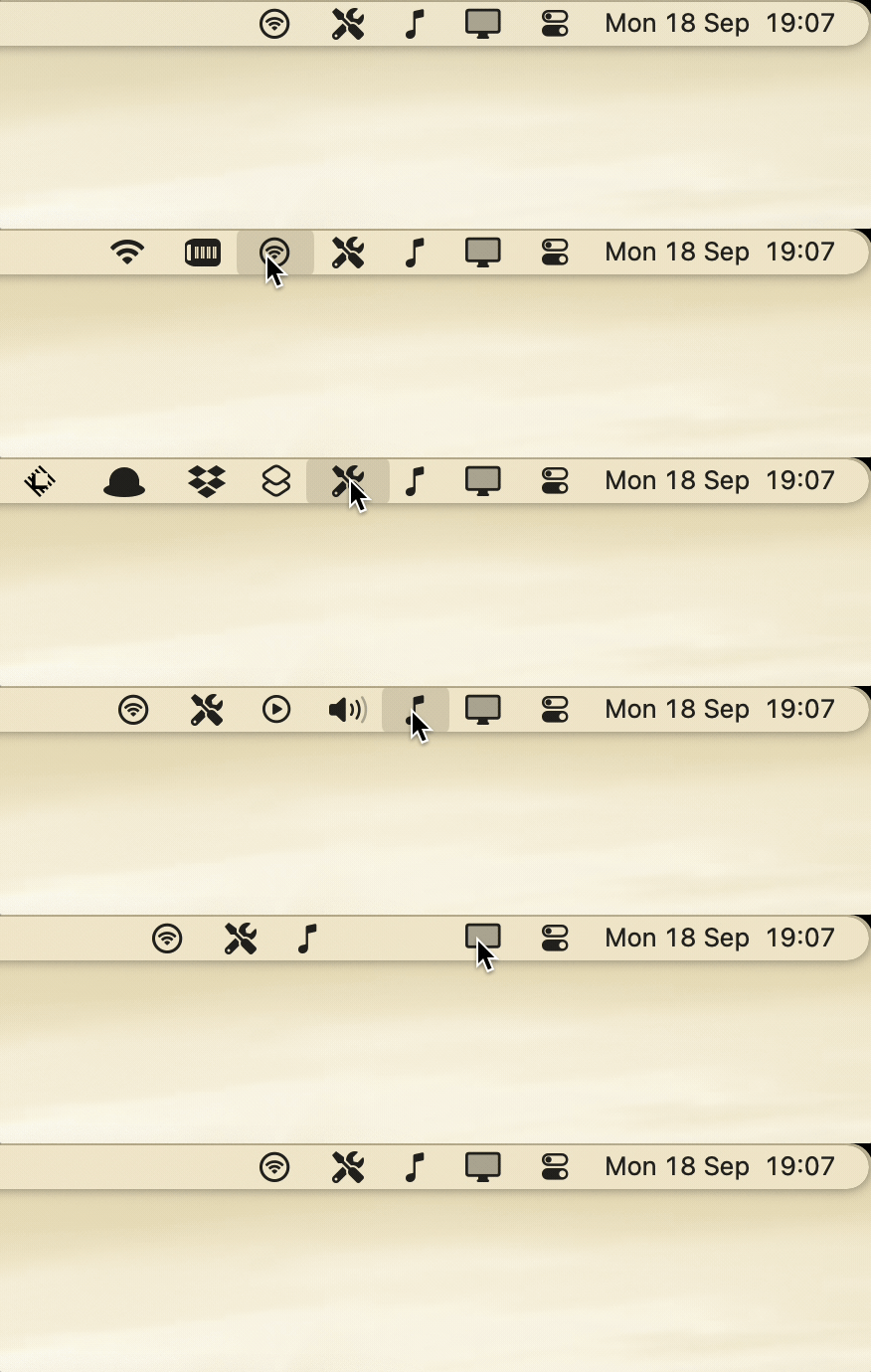
Combine multiple menu bar items into one customisable menu bar item, and have quick access to all the menu bar items within.
For example group all your cloud drive apps together like Dropbox, OneDrive, Google Drive.
Have a group for connection related items such as Wi-Fi and VPN.
And another for media related items, like volume, media controls, airplay.
This can be a great way to have access to all your menu bar items on a MacBook Pro or Air with limited menu bar space due to the screen notch.
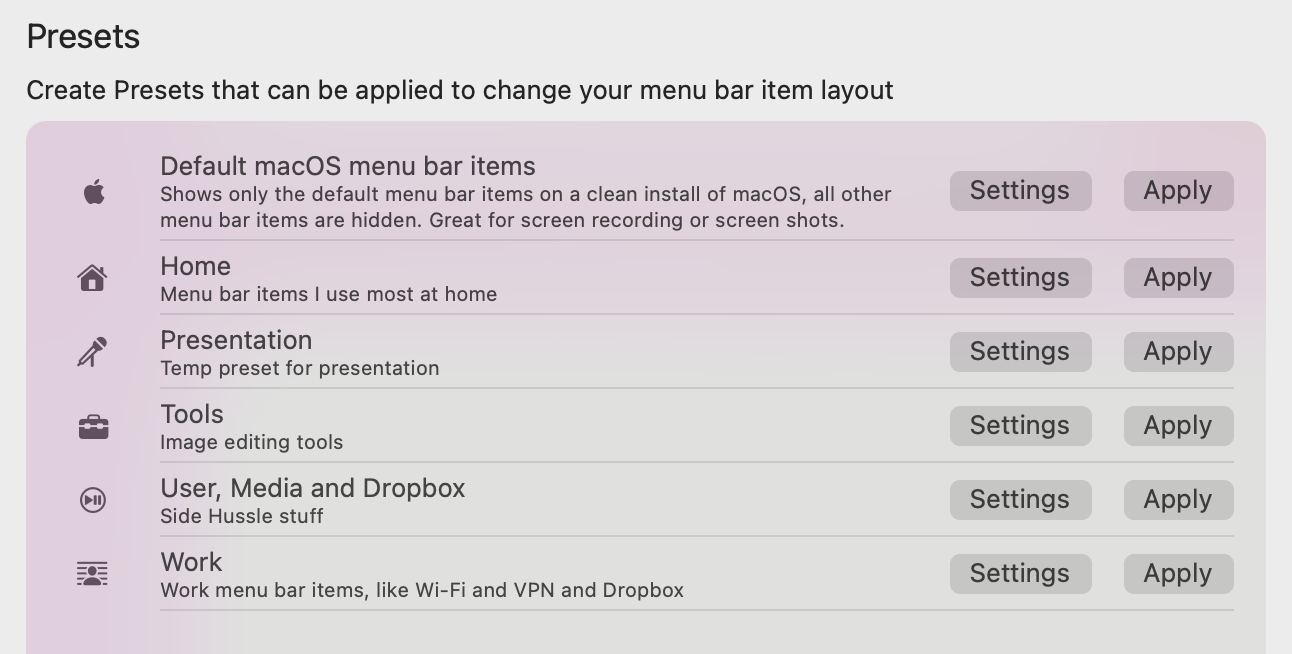
Create as many presets as you want and always have the right menu bar items available for your current workflow.
Show the macOS default menu bar items when recording your screen or screen sharing
Show work specific menu bar items in work hours, then social media items when at home... the possibilities are endless.
Presets can be automatically applied via triggers and also by macOS Focus modes.
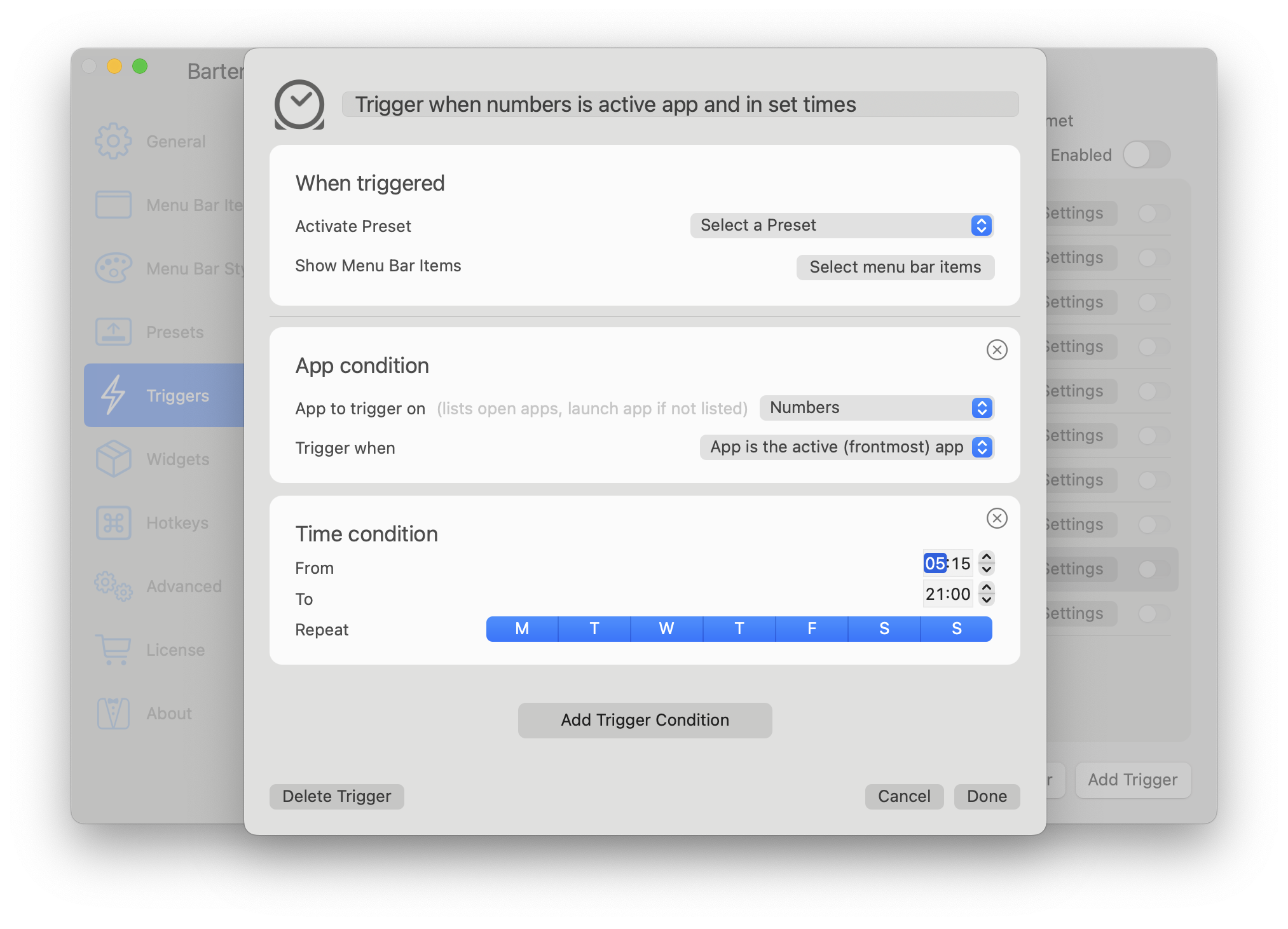
With a completely new Trigger system
you can apply a preset automatically, or show a set of menu bar items whenever your trigger conditions are met. Triggers conditions currently include
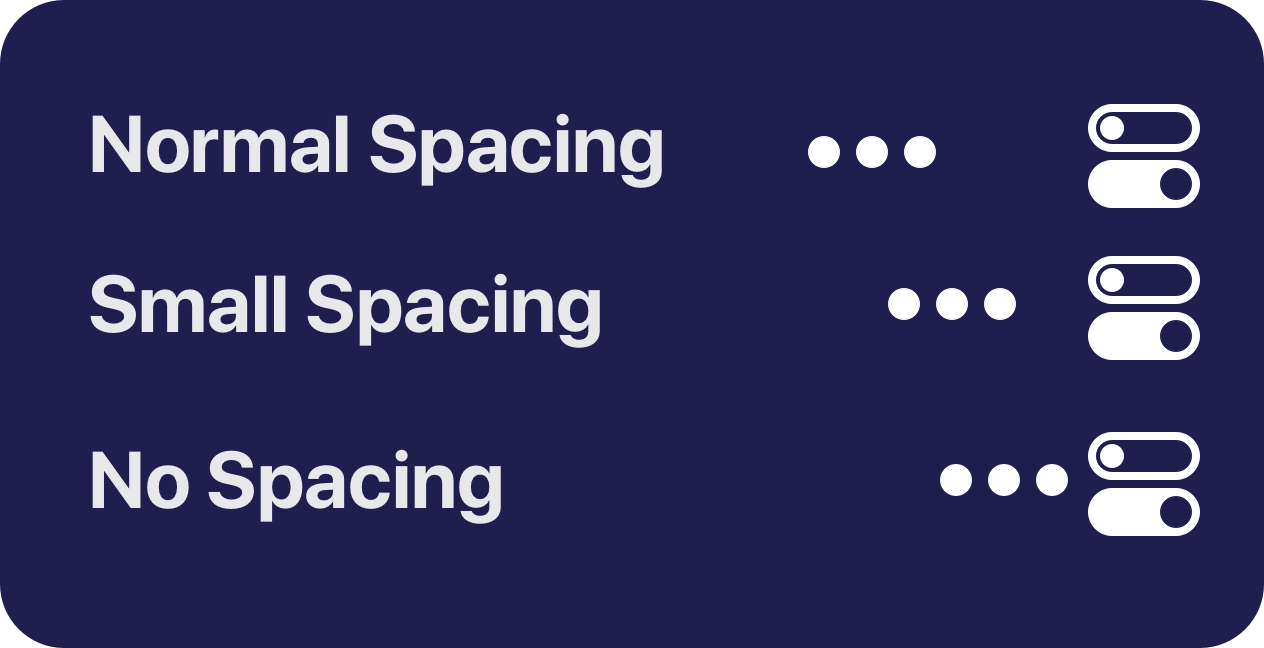
Reduce the space between menu bar items using Bartender, allowing you to have more menu items onscreen before reaching the macbook notch. Or just purely for style.
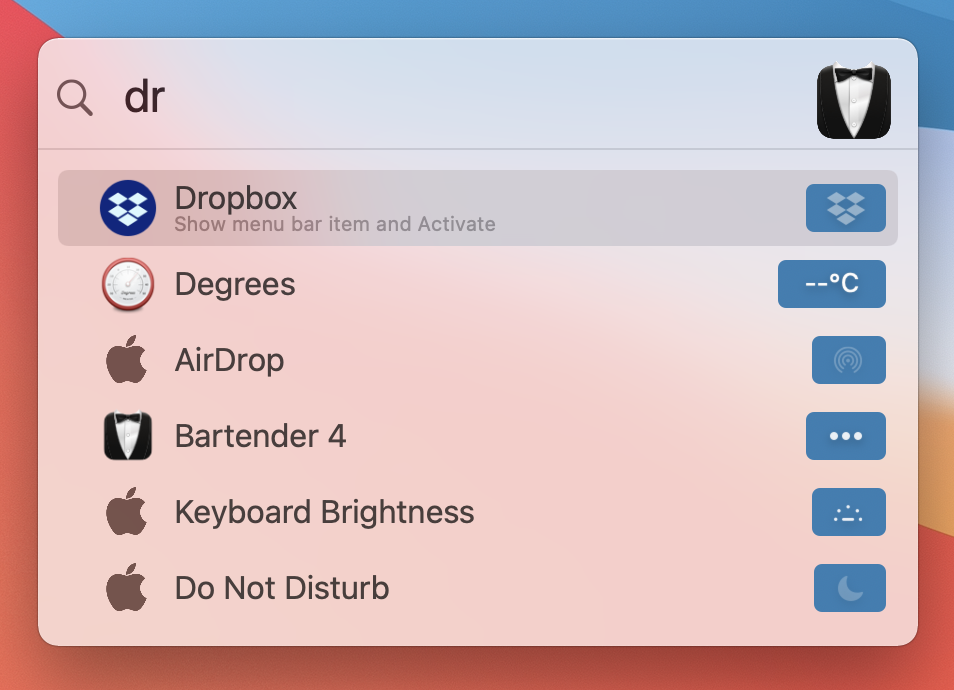
Quick Search will change the way you use your menu bar apps.
Instantly find, show, and activate menu bar items, all from your keyboard.
* the macOS screen capture menu bar item can show when using this. more info
Bartender 5 is designed for all the great changes in macOS Sonoma.
Bartender 5 runs native and lightning-fast on Apple Silicon and Intel macs.
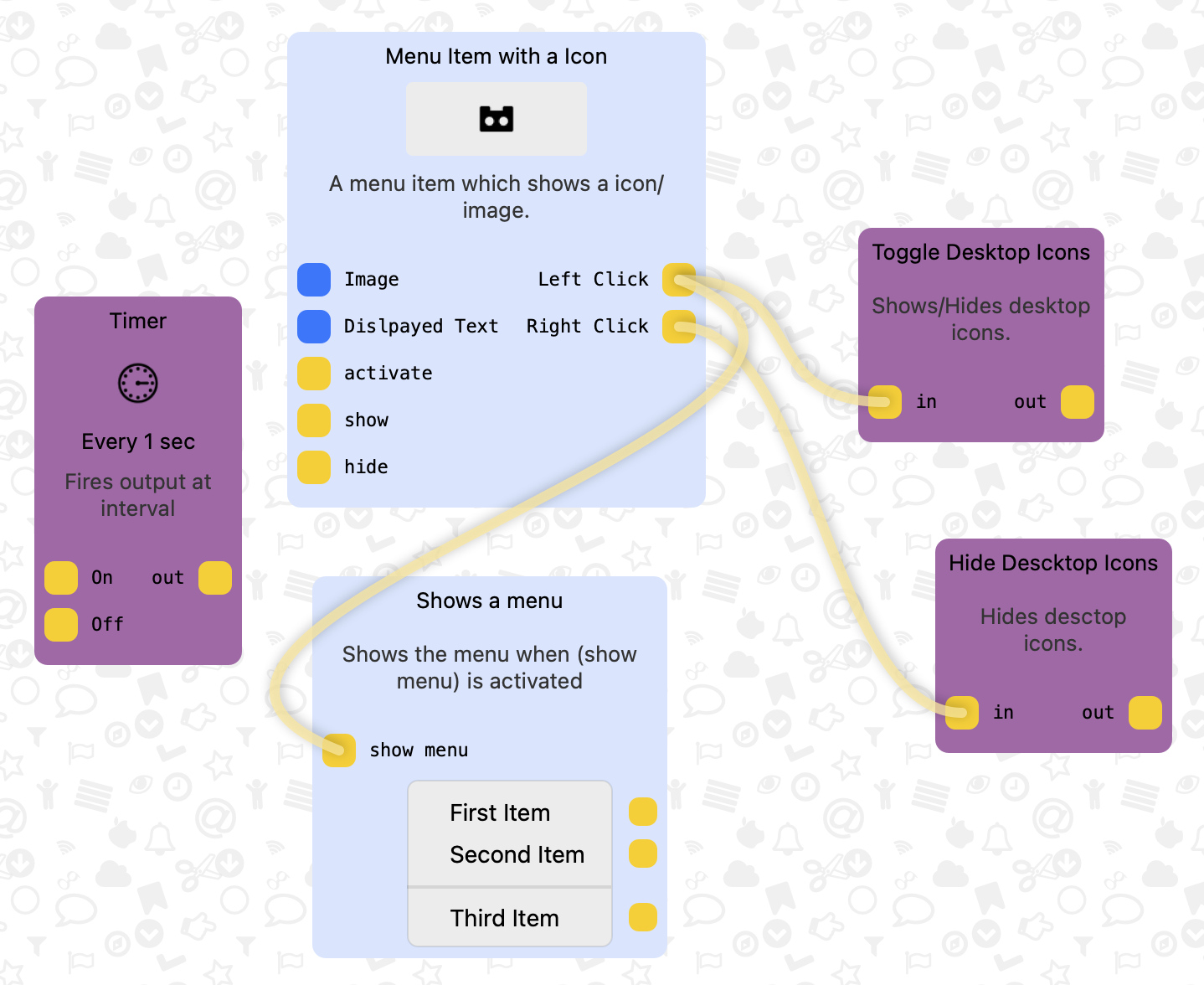
Create your own menu bar items
With Bartender widgets you can create your very own custom menu bar items, that trigger pretty much any action you want, no coding required.
Add hotkeys for any menu bar item; this can show and activate any menu bar item via any hotkey you assign.
With Spacers, your menu bar is uniquely your own, with the ability to customize menu item grouping and display labels or emojis to personalize your menu bar.
Use Apple Script to show and activate menu bar items. Fantastic for some advanced workflows.
Swap shown items for your hidden ones to take up less menu bar space, allowing you to have more menu bar items on a smaller screen.
You can choose where new menu items will appear in your menu bar, shown for instant access, or hidden for less distraction.
One of the film’s most delicate achievements is its construction of the "enemy." The closest thing to a villain is the American pilot Donald Curtis, a vain, arrogant showman. The actual antagonists, the Mamma Aiuto Gang (sky pirates), are bumbling businessmen of crime who schedule their heists around lunch. This isn’t mere comic relief; it’s a deliberate world-building choice. Miyazaki presents the Adriatic in the late 1920s as a small, insulated pond where honor still exists among thieves. The dogfights are practically ballets, governed by rules, respect, and the simple joy of flight.
In the film’s coda, we are told that Marco’s curse lifted—he returned to human form. But we never see it. We only see his red plane, now piloted by Fio, flying over Gina’s garden. The story ends not with a transformation, but with a promise.
Ultimately, Porco Rosso is Miyazaki’s most personal and bittersweet film. It is for anyone who has ever felt out of step with their own time, who has survived a tragedy they couldn’t prevent, and who knows that sometimes, the only honorable thing to do is to turn your back on history, pour a glass of wine, and fly alone into a golden sunset. porco rosso explication
On the surface, Hayao Miyazaki’s Porco Rosso (1992) is a sun-drenched, nostalgic romp. It features dashing seaplane pilots, sky pirates too incompetent to be truly villainous, and a hero who happens to be a anthropomorphic pig. But beneath its Mediterranean charm lies a profound and melancholic meditation on post-war guilt, the obsolescence of the masculine ideal, and the difference between running away and finding a sanctuary.
Miyazaki’s direction is key to the explication. The film is obsessed with mechanical detail—rivets on a fuselage, the grease on an engine, the way light reflects off a cockpit windshield. This fetishization of the machine is a form of meditation. For Porco, the act of piloting is a prayer. When he is alone in the clouds, the radio off, the horizon infinite, he is not a cursed man or a political refugee. He is pure motion, pure skill, pure being . One of the film’s most delicate achievements is
Fio, by contrast, represents the future. She is brilliant, fearless, and utterly unburdened by the masculine guilt that cripples Marco. When she rebuilds his damaged seaplane, she literally gives him a new body to fly with. In the film’s climax, it is Fio’s ingenuity and courage—not Marco’s dogfighting skill—that saves the day. Her kiss on the cheek lifts the "war years" from Marco’s memory, suggesting that the curse of toxic solitude can be broken by a new generation that doesn’t share the old traumas.
The sea itself is rendered as a shimmering, boundless blue—a visual metaphor for freedom. The planes don’t just fly; they glide, stall, and float, connected to the water. This is not the sterile, vertical escape of space travel; it is a horizontal, earthbound flight. Porco is not trying to leave the world; he is trying to find the one part of it that still makes sense. Miyazaki presents the Adriatic in the late 1920s
The film’s emotional core is triangulated between two women: Gina, the worldly nightclub singer, and Fio, the precocious 17-year-old engineering prodigy. Gina represents the past and the possibility of redemption. She has loved and lost Marco (along with his three fallen comrades) and waits for him in her secret garden, a literal oasis of peace. Marco cannot land there; he can only circle overhead, watching from a distance. He is too ashamed to accept her love because he believes his survival is a dishonor.