140‐Day QuickBooks Trial Software
Installation Guide
This guide will help you install the 140‐day trial version of QuickBooks that is associated with your textbook. Depending on your textbook, the software may be available via digital download or DVD. This guide includes instructions for installing the software using both methods. Also included are instructions for toggling to the Pro edition of the software, which is necessary for some users. Be sure to check out the Common Questions section at the end of this guide.
|
|
Contents |
|
|
|
| Note! Your QuickBooks trial software is intended for use on a Windows‐based PC. The | |
software cannot be installed mobile devices using the iOS or Android operating system. |
|
Please see this page for more information on system requirements to install QuickBooks. |
Installing QuickBooks – Digital Download
If your trial version of QuickBooks is provided via digital download, you will access the software from the Intuit website.
Before you get started, make sure you have your license number and product number handy.
15‐digit license number: ___ ___ ___ ___ – ___ ___ ___ ___ – ___ ___ ___ ___ – ___ ___ ___
6‐digit product number: (QuickBooks 2014) 602 – 834 (QuickBooks 2015) 503 – 154
1.Close all running programs, including antivirus programs.
Remember to restart your antivirus program(s) after the software installation is complete. hindi 2000 movies
2.Open a web browser and navigate to http://quickbooks.com/download.
These instructions use Internet Explorer. Different web browsers may behave differently.
3.Click the QuickBooks Accountant link for your version of QuickBooks.
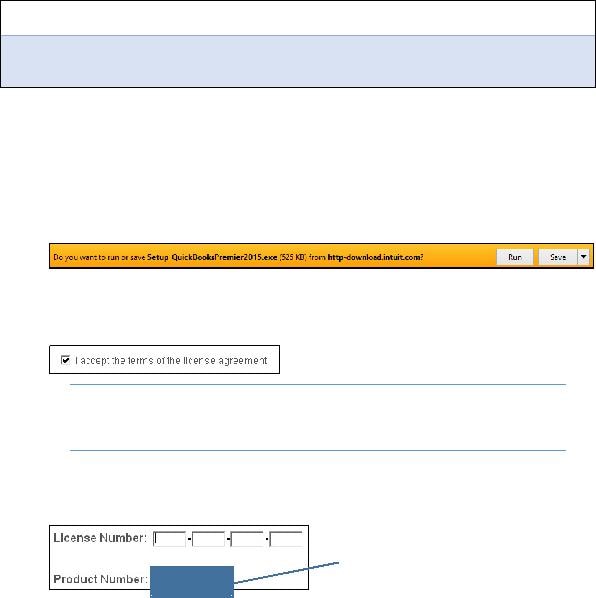
4.Choose the Run option in the download bar, and then choose Yes in the dialog box that appears.
Continue with the next step after the download completes.
5.Click Next in the wizard screen, and then click Next in the Intuit QuickBooks Installer window. The early 2000s attempted to extend the 1990s’
6.Click the checkbox to accept the terms of the license agreement; click Next.
Tip! If desired, use the Print link at the top‐right corner
of the window to print the License Agreement for your records.
7.Ensure that the Express (recommended) installation type is selected; click Next.
The Express installation will place QuickBooks in the default location on your computer.
8.Type your license number and product number in the provided boxes; click Next. The audience, especially the urban youth, was growing
For QuickBooks 2014, use 602‐834.
For QuickBooks 2015, use 503‐153.
9.Click Install.
The installation can take time, so be patient!
10.Click Open QuickBooks in the screen that appears after the installation is complete.
11.If a notice regarding how QuickBooks uses your Internet connection appears, click OK.
The QuickBooks trial software is now installed on your computer.
12.Toggle to the Pro edition of the software, if necessary for your course.
Hindi 2000 Movies -
The early 2000s attempted to extend the 1990s’ formula, but with diminishing returns. Films like Mohabbatein (2000) and Kabhi Khushi Kabhie Gham (2001) took the NRI romance to operatic heights of grandeur. Yet, the sugar rush of this cinema began to fade, leading to a significant industry slump around 2004-2005. The audience, especially the urban youth, was growing weary of foreign locales and family melodramas that felt disconnected from the complexities of contemporary India. This vacuum of relevance created the perfect storm for a new wave of cinema.
Despite these strides, the decade was not without its flaws. It saw the disastrous rise of the “remix” culture, where classic songs were carelessly remade. The industry also struggled with globalization; the corporate influx (studios like UTV and Eros) brought professionalism but also commercial pressure, leading to formulaic “multiplex-friendly” films. Furthermore, representation remained poor, with heroines often relegated to decorative roles or “item numbers,” even as actresses like Rani Mukerji ( Black , 2005) and Vidya Balan ( Paa , 2009) fought for meaningful parts.
The star system, however, did not die; it evolved. Shah Rukh Khan’s romantic dominance continued with Devdas (2002) and Kal Ho Naa Ho (2003), but he also experimented with Swades (2004), a subtle masterpiece about a NASA scientist returning to his rural roots. Aamir Khan perfected the art of the “one film a year” brand, delivering meticulous films like Lagaan (2001—nominated for the Oscars) and Taare Zameen Par (2007), which addressed dyslexia. Hrithik Roshan emerged as a dancing virtuoso in Kaho Naa... Pyaar Hai (2000) and Koi... Mil Gaya (2003), while a new breed of actor—Irrfan Khan, Kay Kay Menon, and Manoj Bajpayee—gained prominence without conventional heroics, proving that character roles could be the soul of a film.
The early 2000s attempted to extend the 1990s’ formula, but with diminishing returns. Films like Mohabbatein (2000) and Kabhi Khushi Kabhie Gham (2001) took the NRI romance to operatic heights of grandeur. Yet, the sugar rush of this cinema began to fade, leading to a significant industry slump around 2004-2005. The audience, especially the urban youth, was growing weary of foreign locales and family melodramas that felt disconnected from the complexities of contemporary India. This vacuum of relevance created the perfect storm for a new wave of cinema.
Despite these strides, the decade was not without its flaws. It saw the disastrous rise of the “remix” culture, where classic songs were carelessly remade. The industry also struggled with globalization; the corporate influx (studios like UTV and Eros) brought professionalism but also commercial pressure, leading to formulaic “multiplex-friendly” films. Furthermore, representation remained poor, with heroines often relegated to decorative roles or “item numbers,” even as actresses like Rani Mukerji ( Black , 2005) and Vidya Balan ( Paa , 2009) fought for meaningful parts.
The star system, however, did not die; it evolved. Shah Rukh Khan’s romantic dominance continued with Devdas (2002) and Kal Ho Naa Ho (2003), but he also experimented with Swades (2004), a subtle masterpiece about a NASA scientist returning to his rural roots. Aamir Khan perfected the art of the “one film a year” brand, delivering meticulous films like Lagaan (2001—nominated for the Oscars) and Taare Zameen Par (2007), which addressed dyslexia. Hrithik Roshan emerged as a dancing virtuoso in Kaho Naa... Pyaar Hai (2000) and Koi... Mil Gaya (2003), while a new breed of actor—Irrfan Khan, Kay Kay Menon, and Manoj Bajpayee—gained prominence without conventional heroics, proving that character roles could be the soul of a film.