Downloads

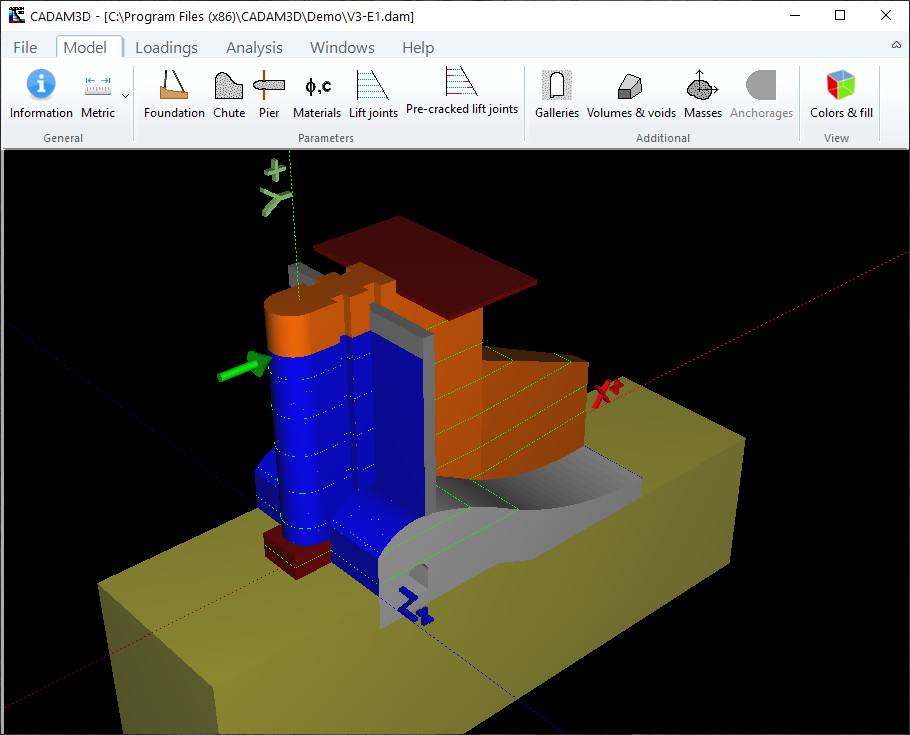
CADAM3D is a user-friendly software based on the gravity method originally developed for one of the world biggest concrete dam owner, Hydro-Quebec, and for Dams and Hydrology of the Quebec Ministry of Environment (Quebec's legislator for dam safety). CADAM3D is fully functional and is intensively used by Hydro-Quebec since 2005. To our knowledge, no other software similar to CADAM3D is available at this time.
If you perform stability analyzes of concrete hydraulic structures, this software will allow you to perform them much faster and more efficiently. If you are interested in this type of software and would like to try CADAM3D for free, please click on the button "Contact us for a free trial of CADAM3D" to send us a message.
The German language, renowned for its logical structure and grammatical precision, presents a unique challenge to learners: the system of irregular verbs. Unlike the predictable pattern of regular (weak) verbs, which form their past tense and past participle by simply adding the suffix -te or -t , irregular verbs undergo a stem-changing metamorphosis. Often referred to as starke Verben (strong verbs) and gemischte Verben (mixed verbs), these linguistic entities are not arbitrary exceptions to the rule but rather the fossilized remnants of a more ancient, dynamic system of conjugation. Understanding German irregular verbs requires moving beyond rote memorization to recognize their historical patterns, their categorical behaviors, and their essential role in fluent communication. Defining the Irregular: Strong vs. Mixed Verbs In German grammar, a verb is considered irregular if it deviates from the standard paradigm of adding -te to the stem for the simple past (Präteritum) and ge-...-t for the past participle (Partizip II). Regular verbs, like sagen (to say), yield sag-te and ge-sag-t . Irregular verbs fall into two distinct subcategories.
The second, smaller group is the . These verbs combine traits of both weak and strong verbs. Like weak verbs, they add the dental -te suffix in the Präteritum and end in -t in the participle. However, like strong verbs, they undergo a stem-vowel change. The classic example is denken (to think): dachte (thought) and gedacht (thought). Here, the stem vowel changes from e to a , but the weak -te and -t endings remain. Other common mixed verbs include bringen (brachte/gebracht) and wissen (wusste/gewusst). The Three Principal Parts and Ablaut Patterns The cornerstone of mastering these verbs is learning the three principal parts: Infinitiv – Präteritum (3rd person singular) – Partizip II . For the strong verb sehen (to see), these are sehen – sah – gesehen . For the mixed verb nennen (to name), they are nennen – nannte – genannt . german irregular verbs
The first and larger group is the . These verbs do not add a dental -t suffix; instead, they change their stem vowel (and sometimes consonants) to form the past tenses and participle. They also take the participle ending -en . For example, the verb trinken (to drink) becomes trank (I drank) and getrunken (drunk). The vowel changes from i to a to u . The German language, renowned for its logical structure
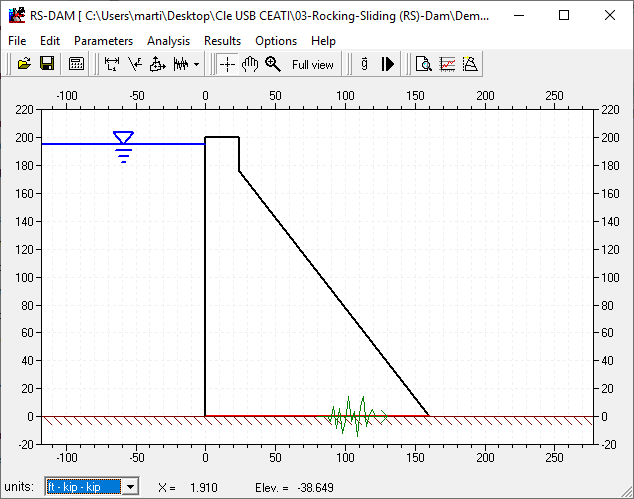
RS-DAM is a computer program that was primarily designed to provide a computational tool to evaluate the transient response of a completely cracked concrete dam section subjected to seismic loads. RS-DAM is also used to support research and development on structural behavior and safety of concrete dams.
RS-DAM is based on rigid body dynamic equilibrium. It performs a transient rocking and/or sliding analysis of a cracked dam section subjected to either base accelerations or time varying forces. Several modelling options have been included to allow users to explore the influence of parameters (e.g. geometry, additional masses, variation of the uplift force upon rotation, hydrodynamic pressures in translation (Westergaard) and rotation, center of rotation moving with sliding, coefficient of restitution of impact, etc...). RS-DAM is developed in a university context and has no commercial aspect.
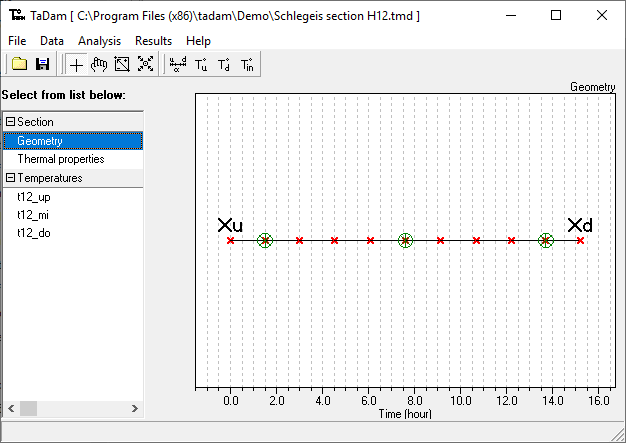
TADAM (Thermal Analysis of concrete DAMs) software employs a new frequency-domain solution technique to solve the 1D thermal transfer problem, allowing the calculation of temperature histories in a concrete dam section.
The direct solution calculates the evolution of the temperature distributions from the temperature histories of the upstream and downstream faces. The inverse solution uses temperature histories, measured inside the section, in order to calculate the temperature fields at the external faces, while taking into account the thermal wave attenuation effects and the phase angles along the section.
TADAM is developed in a university context and has no commercial aspect.