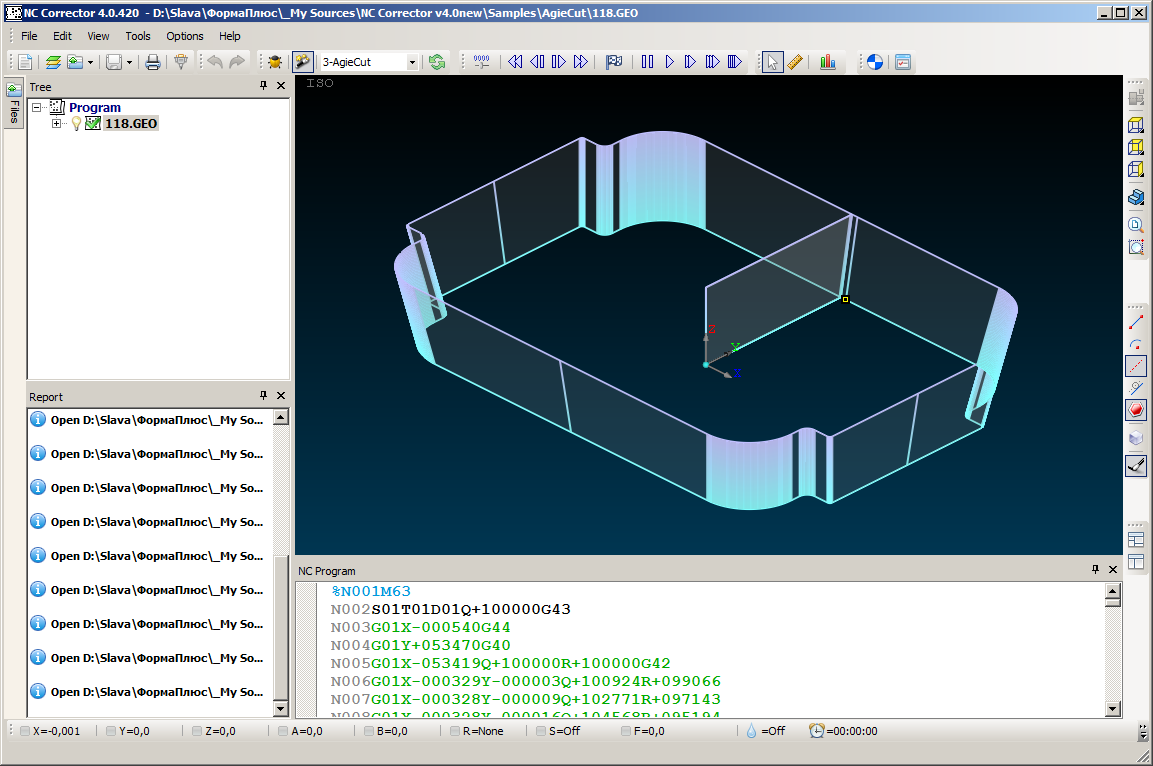
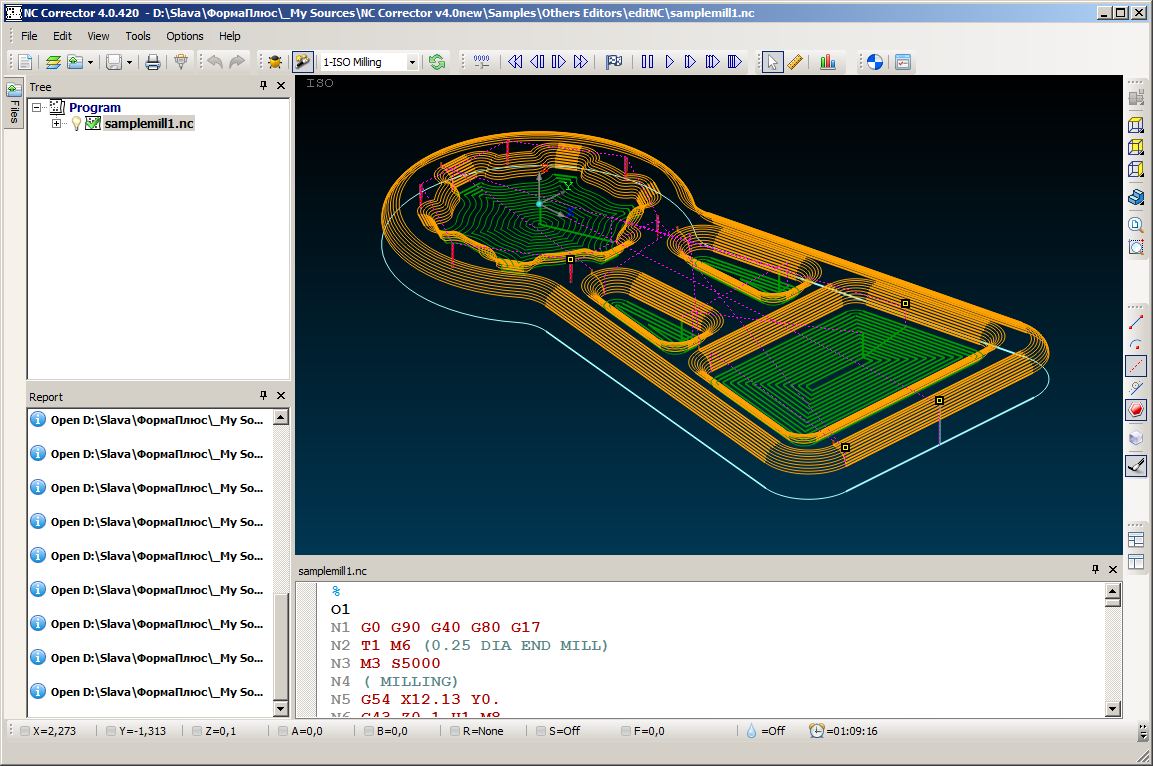
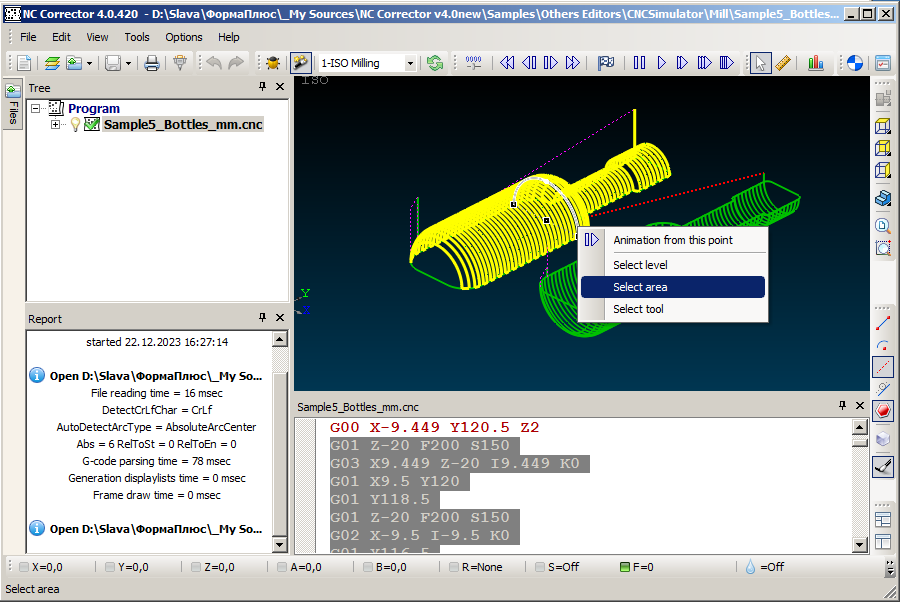
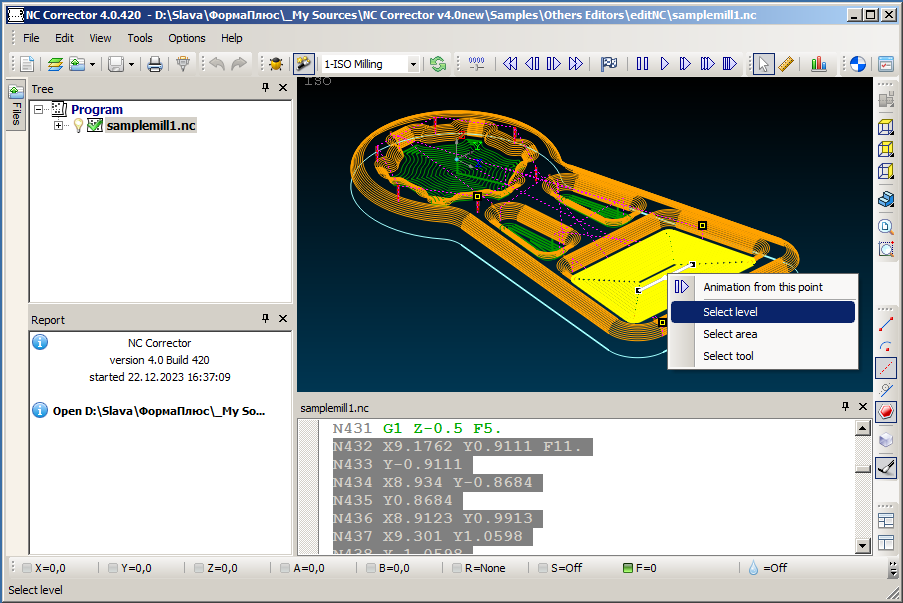
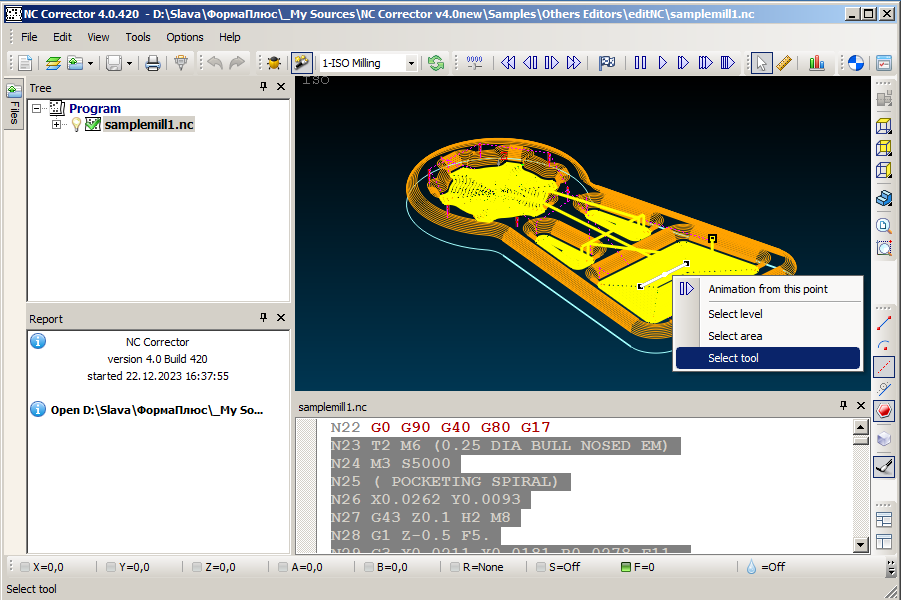
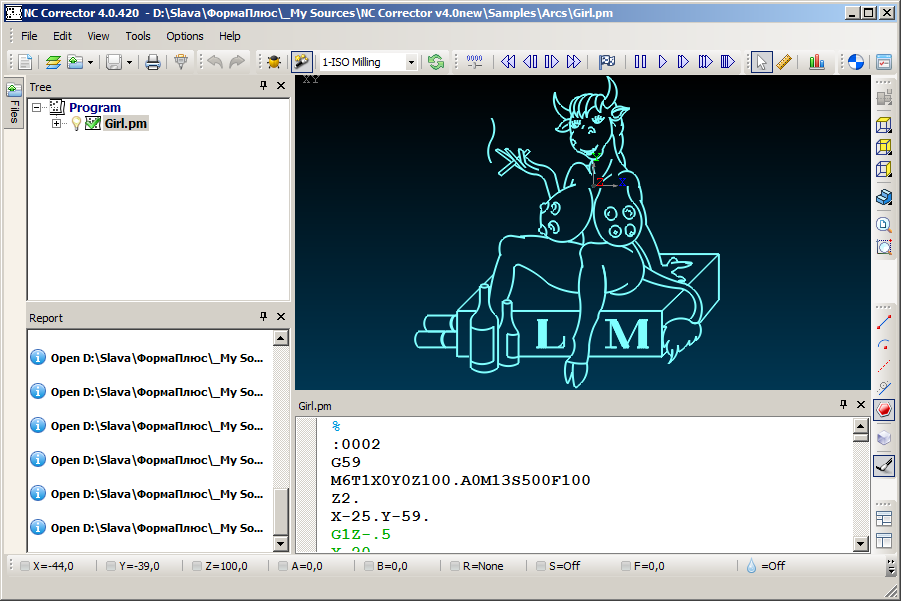
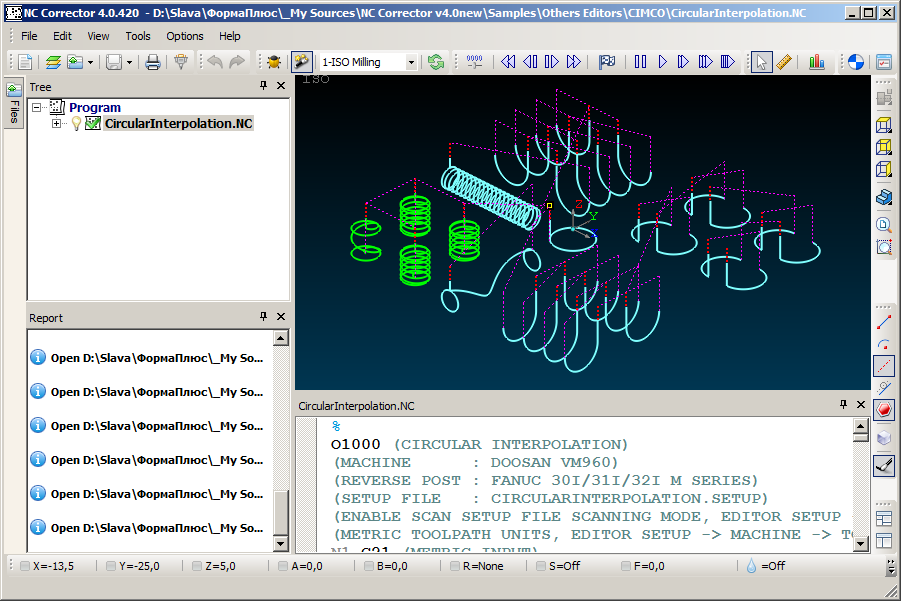
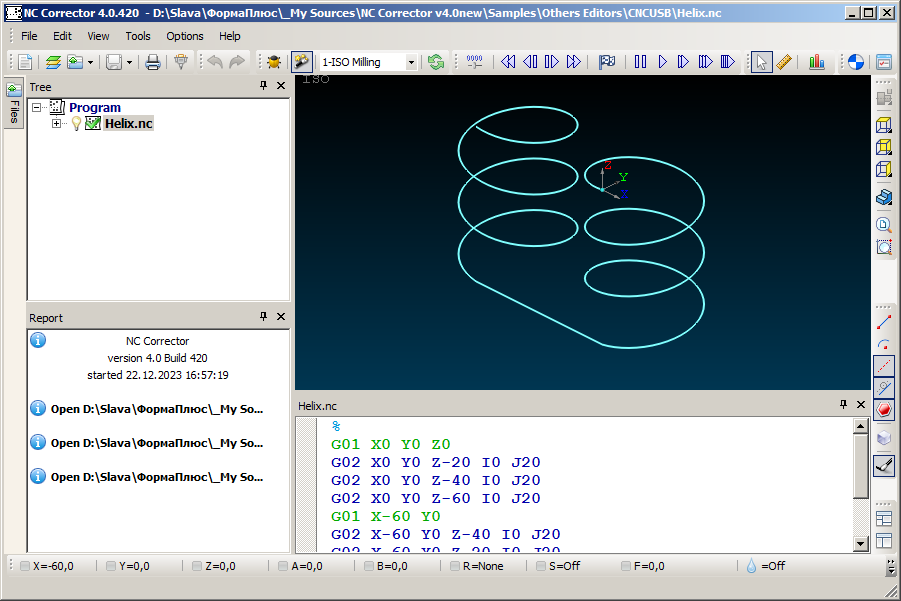
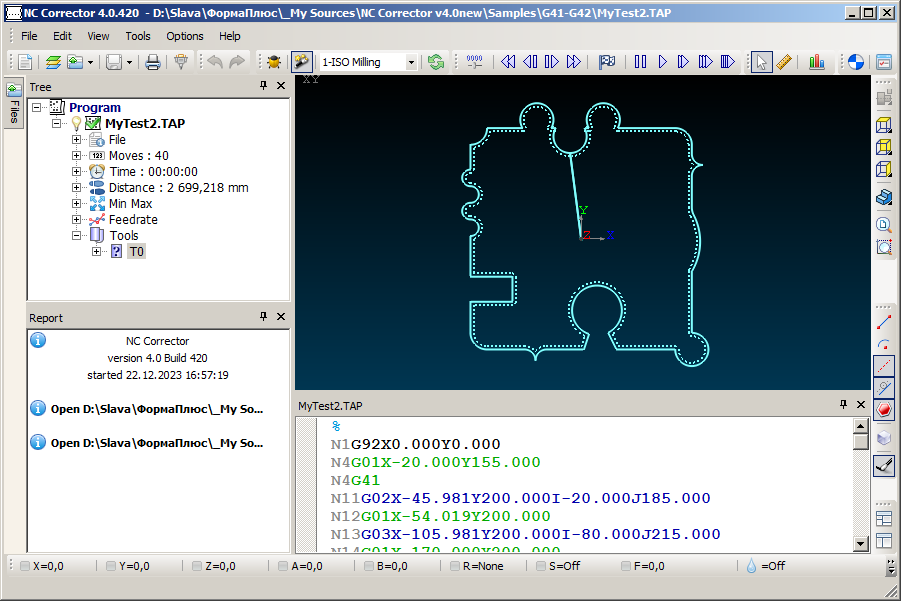
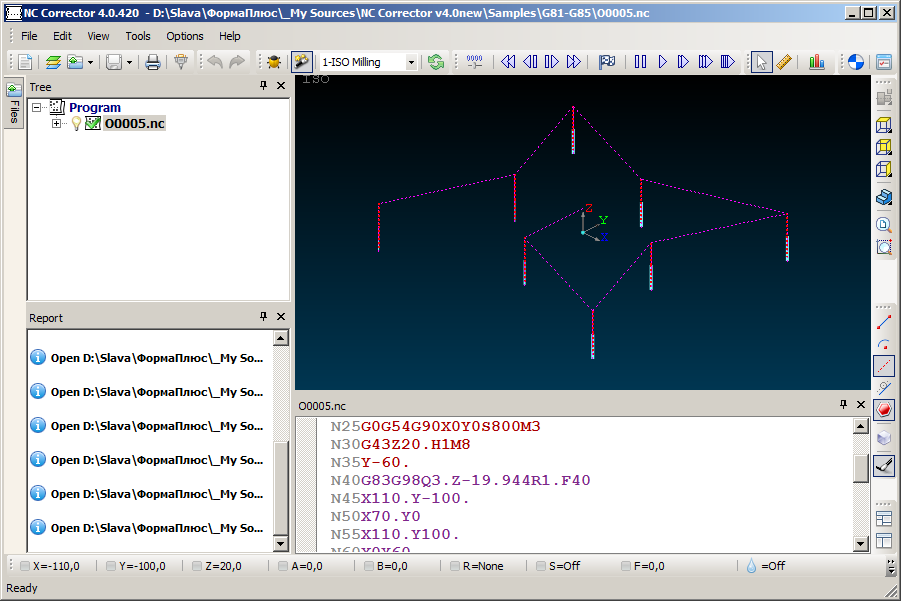
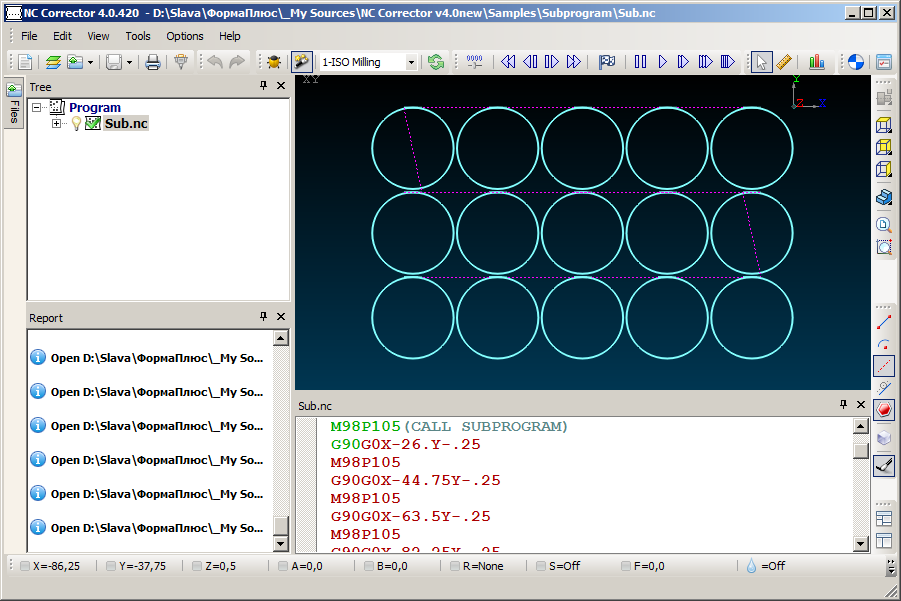
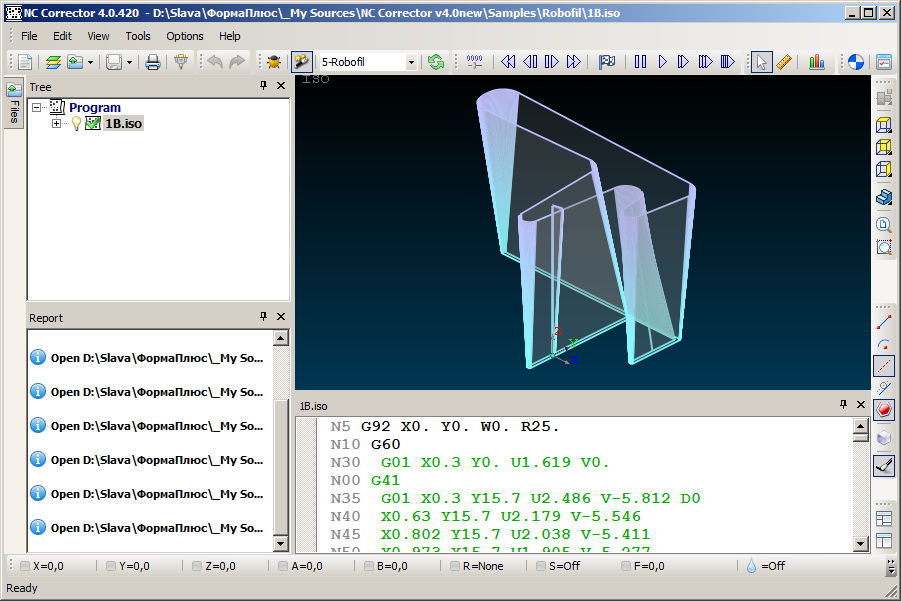
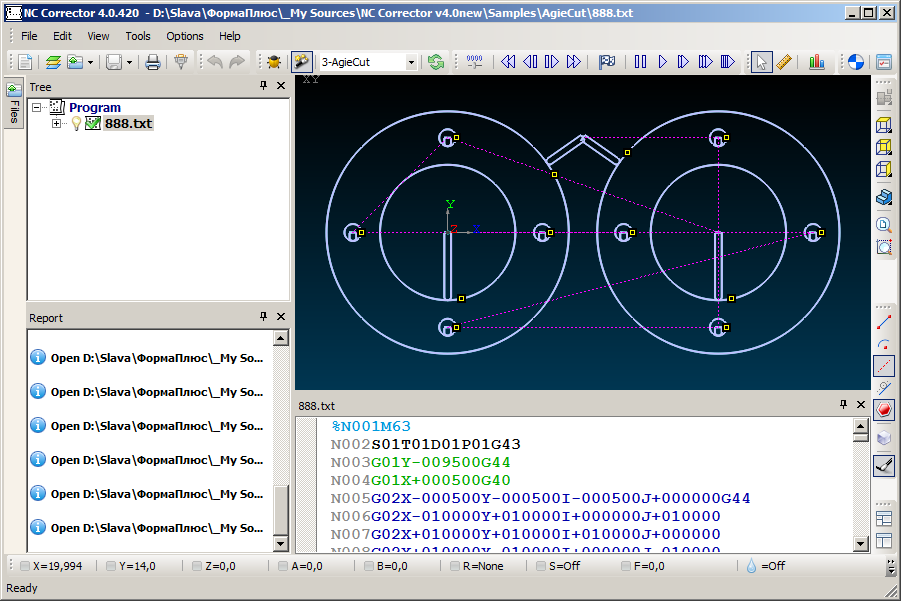
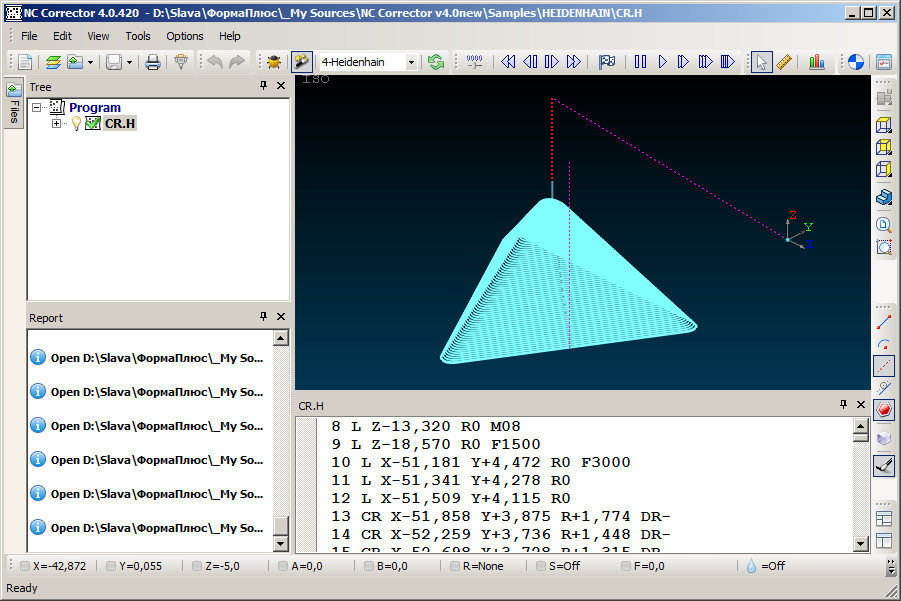
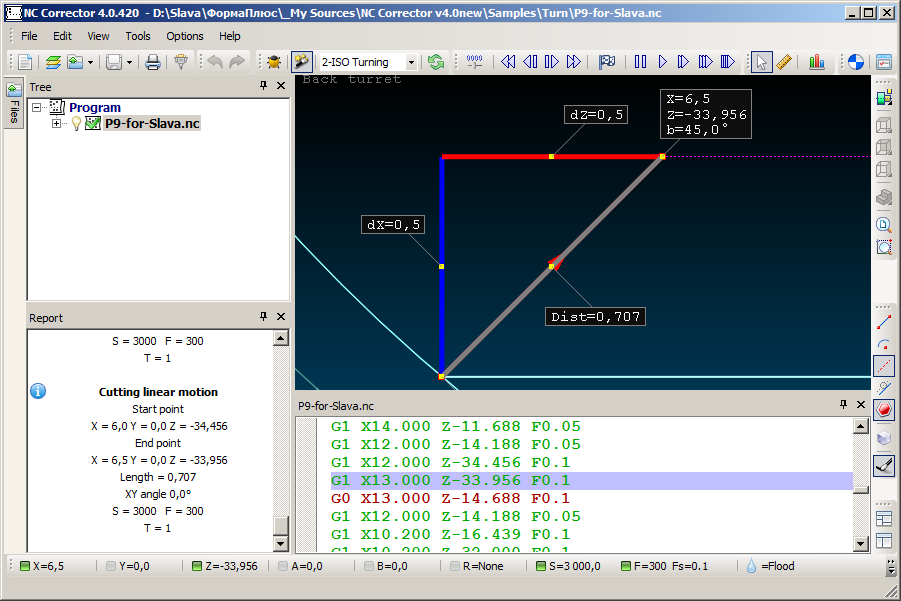
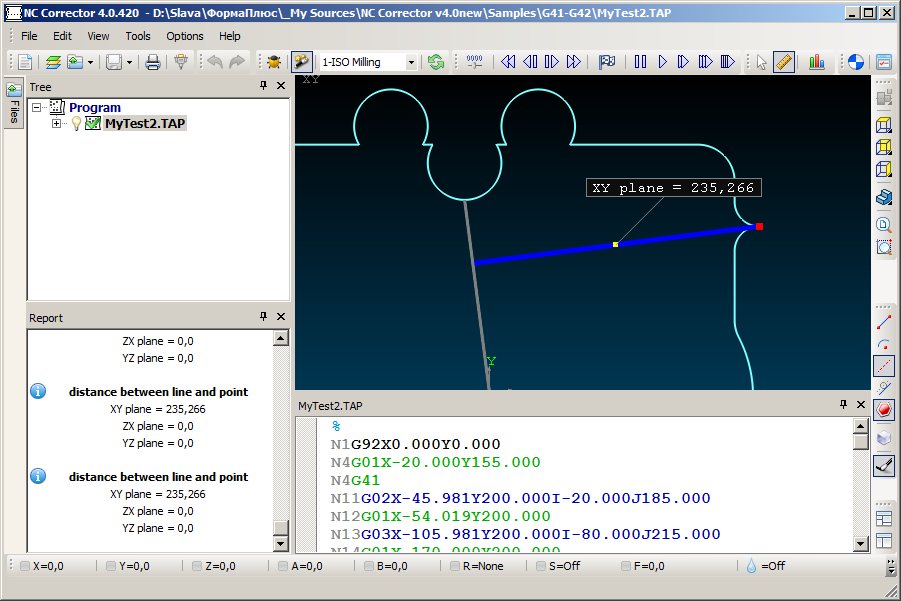
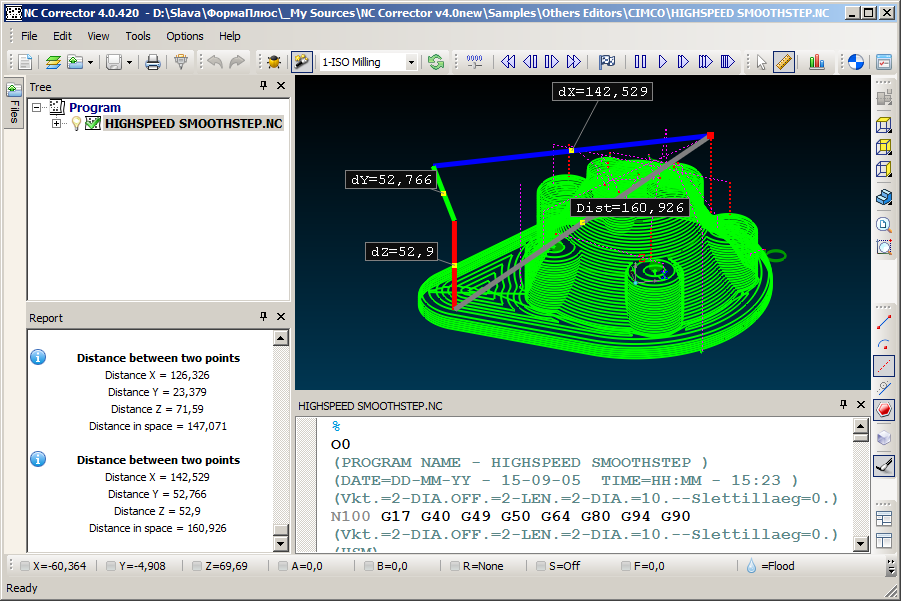
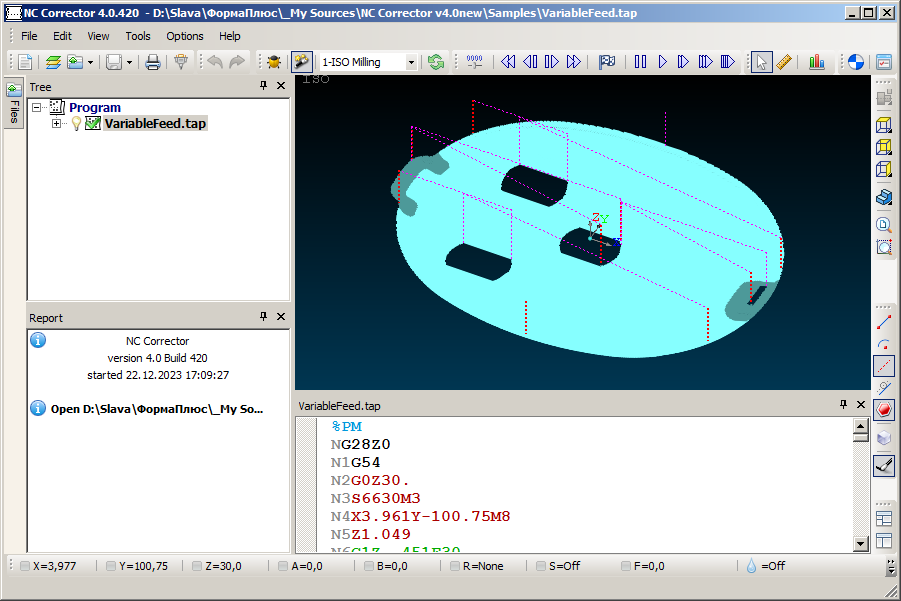
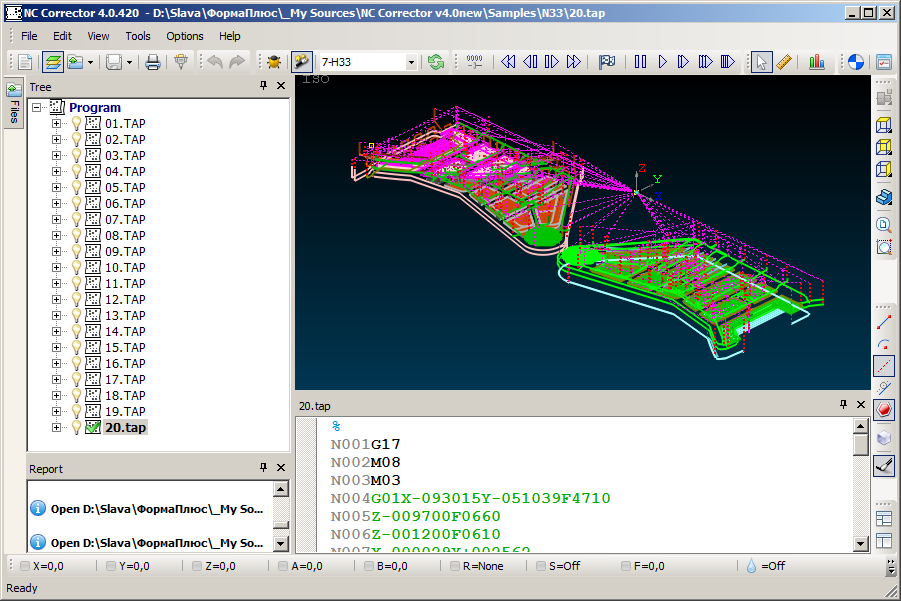
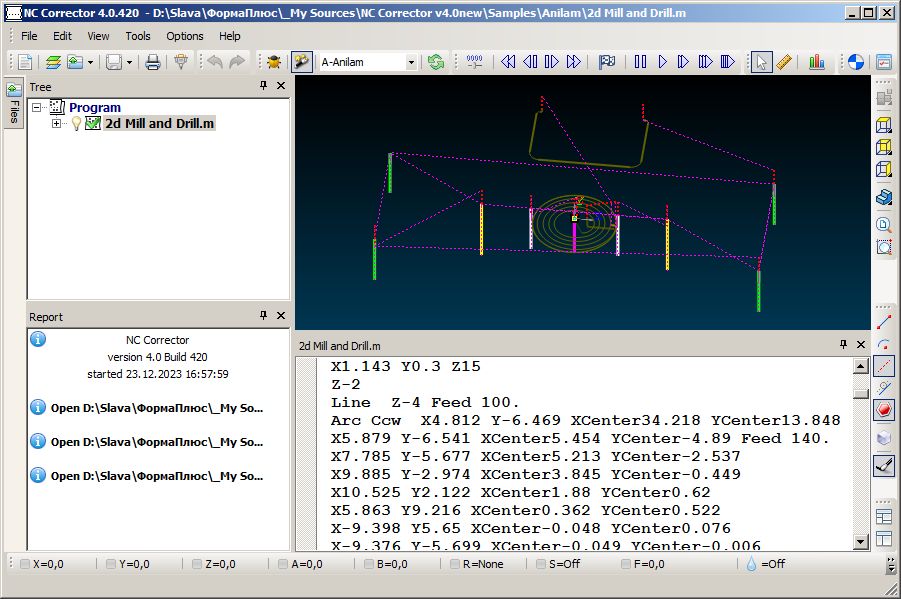
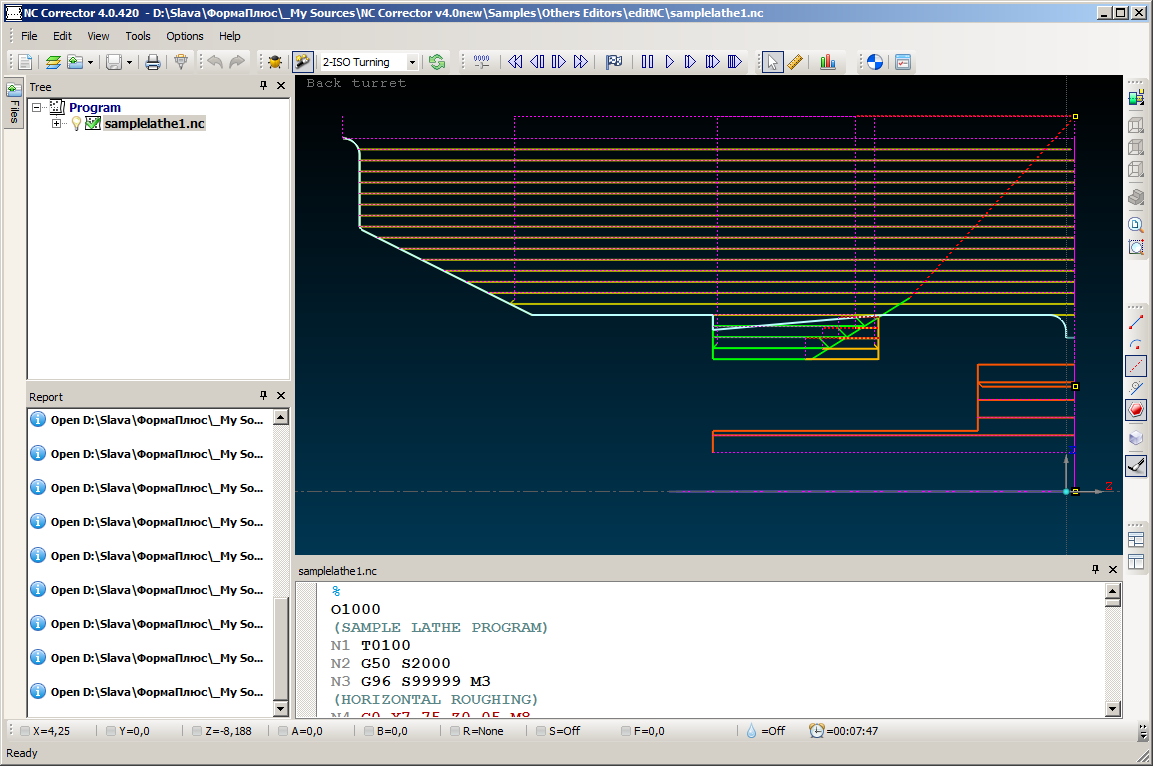
Supports CNC Milling, Lathe, WireEDM machines. Supports basic G and M functions, drilling cycles, subroutines. Automatically detects 5 types of arcs. Export to DXF, APT format. Displays information about the program in the tree. (Machine time, trajectory length, MAX MIN trajectory points, number of segments, arcs, etc.) Hint on G, M codes when hovering the mouse. Shows trajectory points, arc centers, technological stops. Displays the equidistant correction. Frame-by-frame navigation with current program parameters displayed in the status bar. Information about an element when you click on it in the graphics window. Powerful measurement engine and much more.
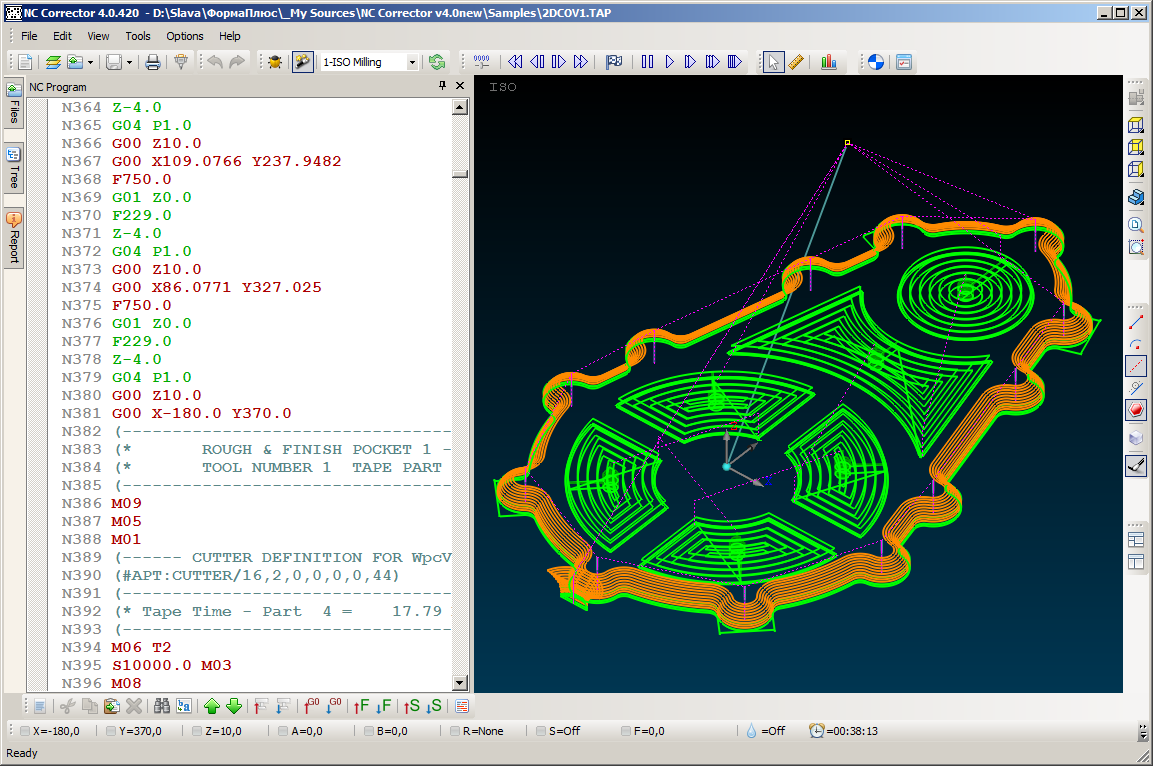
Rendering up to 100 nc-programs simultaneously, with the ability to switch, edit, use all tools, measure.
G-code files can be virtually unlimited in size. The file size is limited only by the hardware resources of your computer.
Dynamic rotation, scaling. Dynamic highlighting of the element under the cursor. Hardware graphics acceleration on OpenGL.
Small size and quick launch of the program.
Windows 95, 98, Me, 2000, XP, 7, 8, 10 compatible.
Fast loading, parsing, rendering of G-code files.
Synchronization of text and graphics windows.
Powerful measurement tool, with dimensions displayed in the graphic window and in the protocol.
A set of standard tools. Working with line numbers, feeds, spaces, comments, etc.
Milling, turning, WireEDM machines. Flexible program settings and machine parameters.
Advanced navigation. Scroll in any direction. Animation with conditional stop.
Customizable user interface. The changes are saved. Reset to original settings.
A tree with the ability to manage downloaded files and display basic information about the G-code file.
Export to DXF and APT format.
Author: [Generated AI Research] Date: October 26, 2023 Subject: Cybersecurity & Digital Forensics 1. Abstract In the contemporary digital landscape, standard file deletion (e.g., moving files to the Recycle Bin or using rm commands) does not physically remove data from storage media. Residual data remains susceptible to recovery via forensic tools. This paper examines EaseUS BitWiper , a professional data destruction tool designed to irreversibly erase data from HDDs, SSDs, USB drives, and memory cards. We analyze its underlying algorithms (DoD 5220.22-M, Peter Gutmann), its adaptation to SSD wear-leveling and TRIM commands, and its compliance with the National Institute of Standards and Technology (NIST) Special Publication 800-88 Revision 1 guidelines. The paper concludes that while BitWiper is effective for mechanical drives, SSD sanitization requires verification of cryptographic erasure or manufacturer-specific ATA Secure Erase. 2. Introduction 2.1 The Problem of Data Remanence Data remanence refers to the residual physical representation of data after attempted erasure. Magnetic force microscopy can detect previous bits on a hard disk drive (HDD) even after a single overwrite. For Solid-State Drives (SSDs), the problem is distinct: wear-leveling algorithms and over-provisioning mean that an OS-level overwrite may not physically address all NAND cells. 2.2 Role of EaseUS BitWiper EaseUS BitWiper is a utility software that aims to solve this by offering bootable media (USB/CD) to write predefined binary patterns over user-addressable sectors. It is marketed toward IT asset disposition (ITAD) professionals, organizations decommissioning drives, and privacy-conscious individuals. 3. Technical Methodology 3.1 Overwriting Standards Supported BitWiper implements several known sanitization algorithms. The efficacy varies by storage type:
Download distribution package, latest build of the program.
DownloadNC-Corrector is a freeware program.
If you like the NC-Corrector, and you want to help, can do it with Paypal
Paypal for donate strunof@ukr.net
Slava Strunov
Kharkiv city, Ukraine
+38(063)-196-59-74
strunof@ukr.net
c-y-b-e-r-p-u-n-k